Objective
To determine the bending moments and stresses in a rectangular plate clamped along the perimeter when the temperature varies linearly through the plate thickness.
Reference
S.P.Timoshenko, S.Voynovsky-Kriger, Plates and shells. — M.: Nauka, 1963.
Problem statement
A rectangular plate of constant thickness clamped along the perimeter is considered. The temperature is constant in planes parallel to the middle surface of the plate and varies linearly through the plate thickness.
To determine the bending moments Mx, My as well as the maximum thermal stress σ.
Design model
The design model is model type 5; 6 DOF per node.
|
|
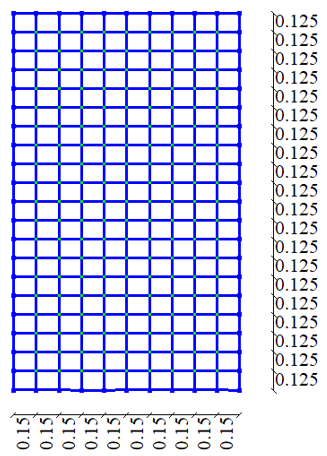
Initial geometry
Geometry
Plate width ax = 1,5 m
Plate length ay = 2,5 m
Plate thickness h = 0,02 m
Material properties
Modulus of elasticity Е = 2*108 kPa
Poisson's ratio ν = 0,2
Boundary conditions
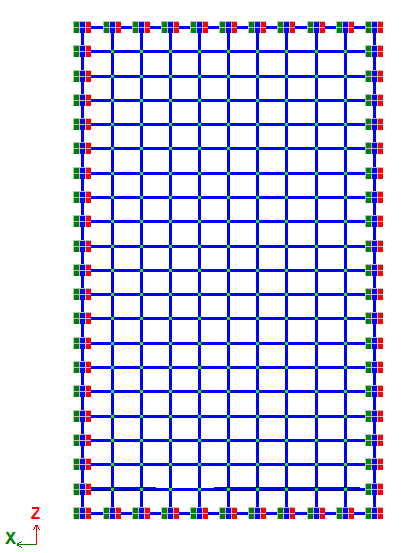
Nodes along the plate perimeter are rigidly restrained.
Loads
Coefficient of linear thermal expansion of the material α = 1,5*10-5 1/C0
Temperature difference between the top and bottom surfaces of the plate ΔТ = 20 C0
Load
The problem is solved in 3D formulation (model type 5).
The model is generated with FE type 44 – arbitrary quadrilateral FE of shell.
Nodes: 231. Elements: 200.
Output data
|
|
|
Design model
|
|
|
|
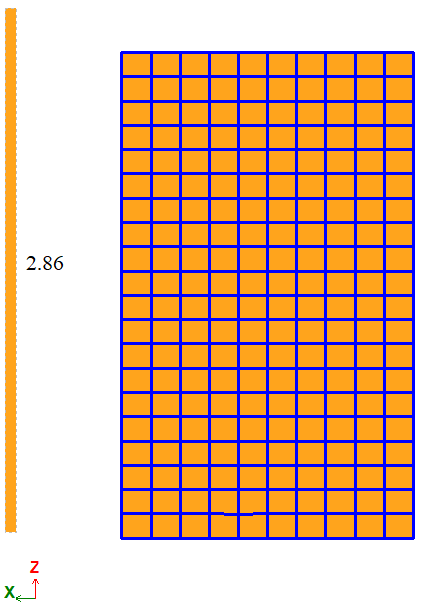
Stress mosaic plot Mx= My, kN*m/m
|
|
|
|
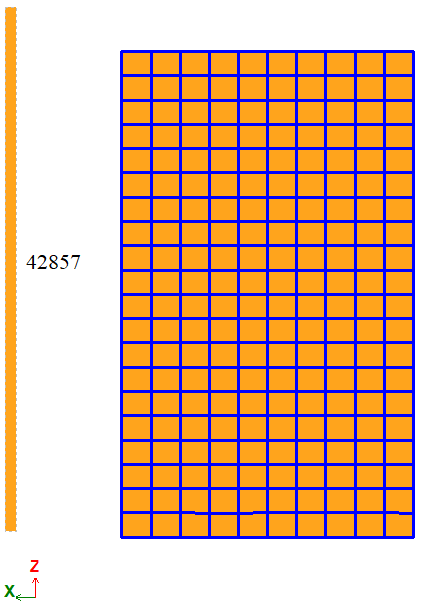
Stress on the top surface of the plate σ, kN/m2
|
Analytical solution
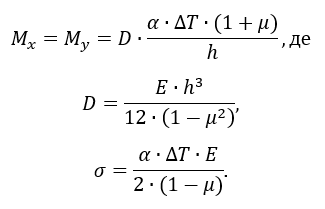
For a plate with a linear temperature variation through its thickness, the bending moments Mx and My and the maximum thermal stress σ can be calculated using the following formulas:
Comparison of calculation results
| Parameter | Theory | LIRA-FEM | Error, % |
| Bending moments Мх = Му, kN*m/m | 2,857 | 2,857 | 0 |
| Maximum thermal stress, kPa | 42857 | 42857 | 0 |
Download verification test
If you find a mistake and want to inform us about it, select the mistake, then hold down the CTRL key and click ENTER.
Comments