Objective
To determine the stress-strain state of the unilateral springs supporting a rigid body.
Reference
A.V. Perelmuter, V.I. Slivker. Design models of structures and their analysis. Kyiv: Stal, 2002, p. 123.
Problem statement
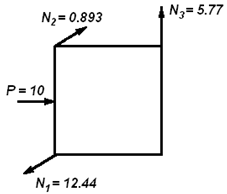
To determine the reactions of the springs that act only in tension.
Design model
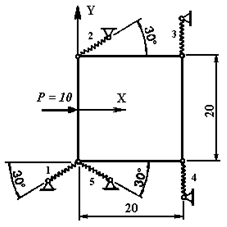
A perfectly rigid body (square) subjected to a concentrated load and supported at its corners by springs of equal stiffness; the springs act only in tension.
|
|
|
Geometry
Overall dimensions of the body L = 20 m
Thickness h = 1 m
Spring inclination angle to the horizontal α = 30°.
Material properties
Modulus of elasticity of the body Е = 2 х 107 tf/m2
Spring stiffness EF/l = 108 tf/m
Boundary conditions
Unilateral restraints.
Loads
P = 10 tf
Notes
The problem is solved in 2D formulation (model type 1 – XOZ-plane).
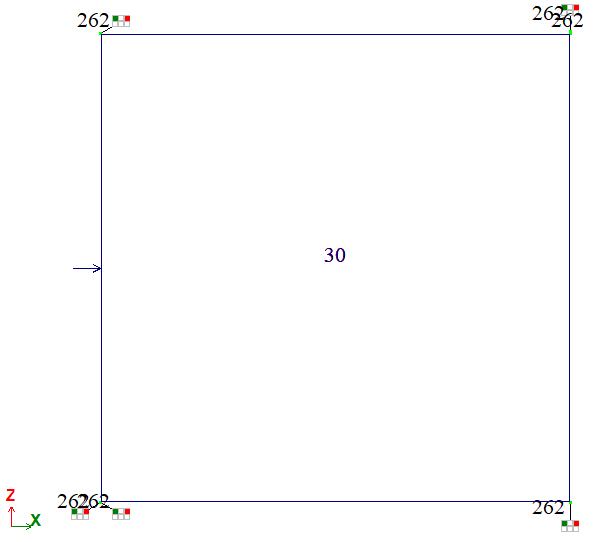
The model is generated with FE type 30 – arbitrary quadrilateral FE of 2D problem (wall-beam) and FE type 262 – 2-node FE of unilateral elastic spring between nodes.
Since nodes of FE type 262 have two degrees of freedom (translations along the global X and Z axes), the element connections at the nodes are pinned.
A step-by-step solution is used to solve the nonlinear problem (number of load steps = 1, minimum number of iterations = 1000).
Nodes: 10. Elements: 6.
Output data
|
|
|
|
Design model with FE types indicated
|
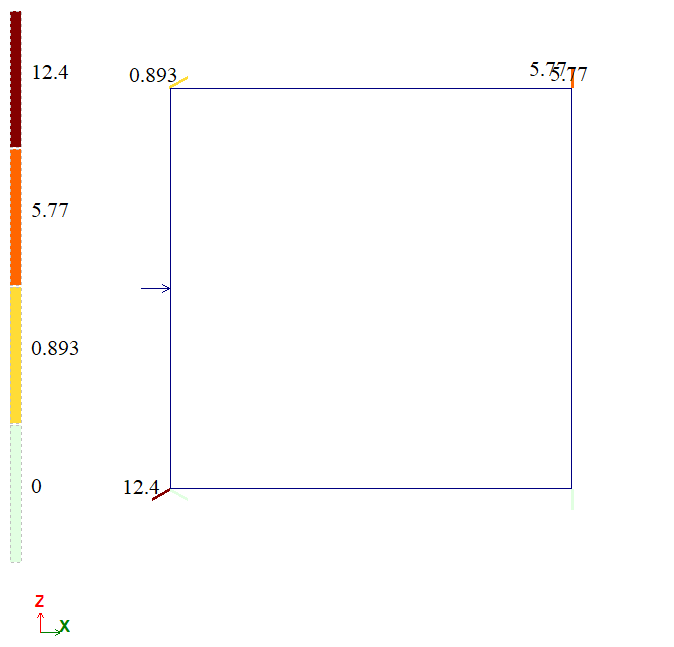
Mosaic plot of forces in the elements of unilateral restraints, t
|
Comparison of calculation results
| The unknown value | Analytical solution | LIRA-FEM | Error, % |
| N1, t | 12,44 | 12,4405 | 0,004 |
| N2, t | 0,89 | 0,8934 | 0,04 |
| N3, t | 5,77 | 5,7737 | 0,064 |
| N4 = N5, t | 0,00 | 0,00 | - |
Download verification test
If you find a mistake and want to inform us about it, select the mistake, then hold down the CTRL key and click ENTER.
Comments