Objective
To determine the deformed state of a cantilever circular bar of constant cross-section under in‑plane concentrated loads and a moment applied at the free end.
Reference
J.S. Przemieniecki, Theory of matrix structural analysis, New York, McGraw-Hill, 1968.
Problem statement
A cantilever circular bar of constant cross-section is subjected at its free end to:
- a concentrated horizontal (normal) load F1;
- a concentrated vertical (tangential) load F2;
- a moment M,
all acting in the plane of the bar.
To determine the horizontal displacement X, the vertical displacement Z, and the rotation angle uY at the free end of the bar (point B).
Design model
The design model is a cantilever circular bar of constant cross-section.
|
|
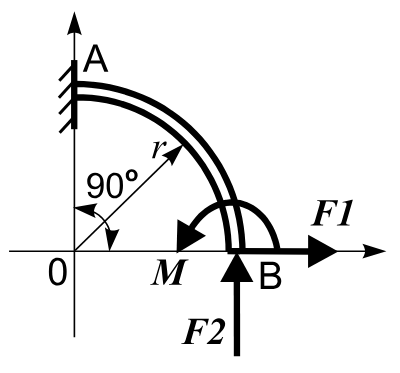
Geometry
Radius of the arc of the longitudinal axis of the cantilever circular bar r = 3,0 m
Central angle corresponding to the arc length of the longitudinal axis of the cantilever circular bar α = 90°
Outer diameter of the circular cross-section of the bar de = 0,02 m
Inner diameter of the circular cross-section of the bar di = 0,016 m
Material properties
Modulus of elasticity Е = 2,0 * 1011 Pa
Poisson's ratio ν = 0,3
Boundary conditions
The boundary conditions are provided by applying restraints in the X, Z, and uY degrees of freedom directions (point A).
Loads
Horizontal concentrated load F1 = 10 N, applied at point B;
Vertical concentrated load F2 = 5 N, applied at point B;
Concentrated moment M = 8 N*m, applied at point B.
Note
The problem is solved in a plane formulation (model type 2).
The model is generated with FE type 10 – arbitrary 3D bar.
Nodes: 25. Elements: 24.
Output data
|
|
|
|
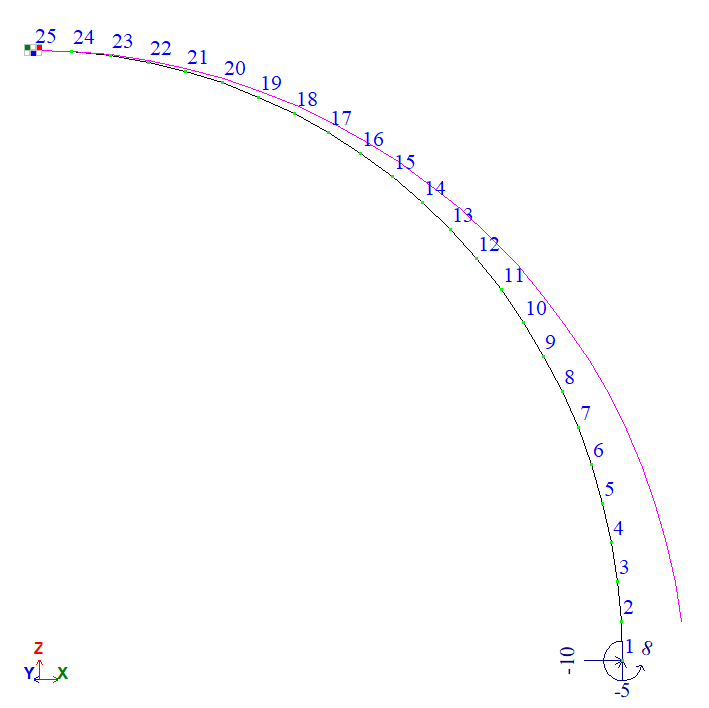
Design and deformed models
|
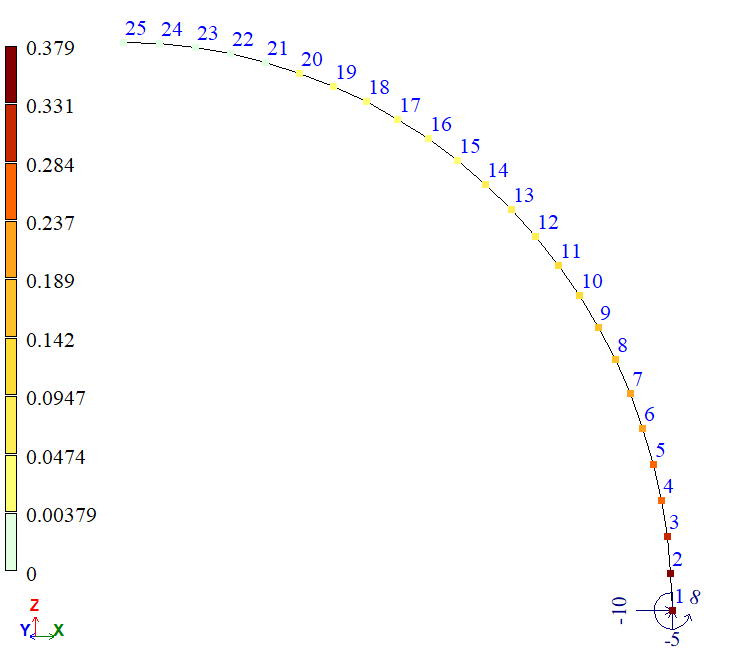
Mosaic plot of horizontal displacements along the global X-axis (w), m
|
|
|
|
|
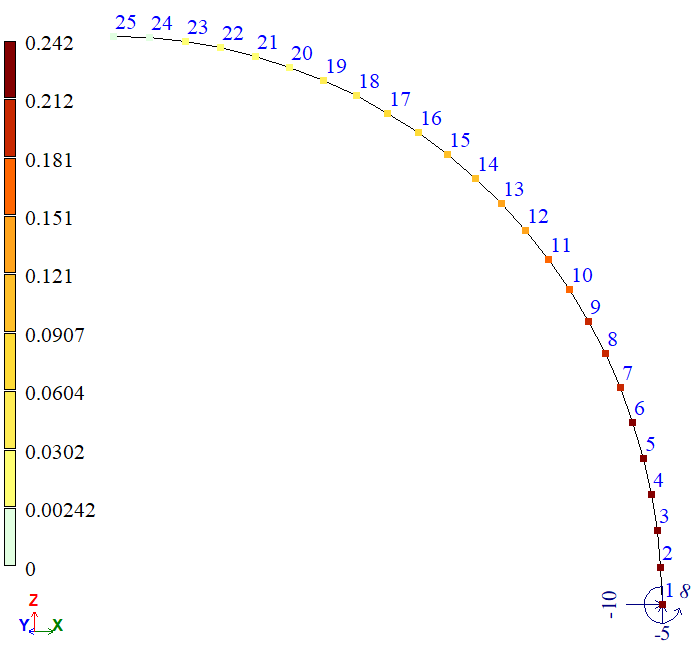
Mosaic plot of vertical displacements along the global Z-axis (w), m
|
Mosaic plot of rotation angles about the global Y-axis (u), rad*1000
|
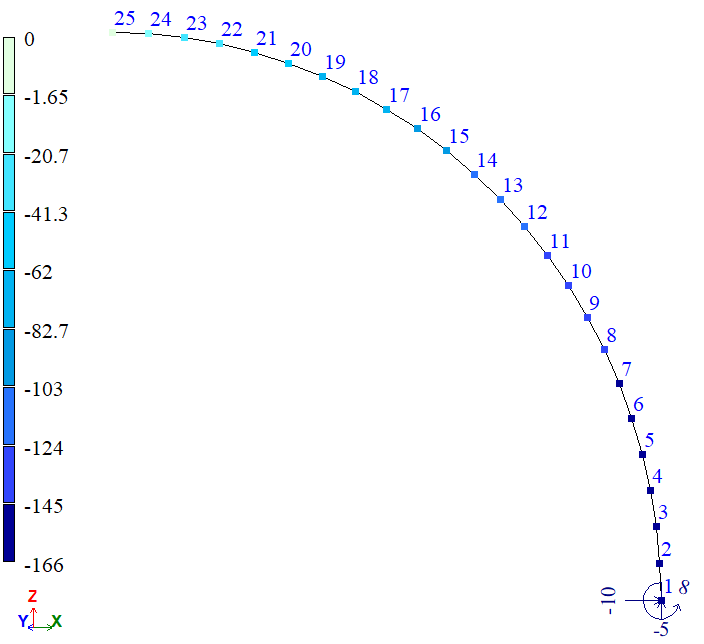
Analytical solution
X = r2/(E*I)*(M+F1*r*π/4+F2*r*1/2;
Z = r2/(E*I)*(M*(π/2-1)+F1*r*1/2+F2*r*(3*π/4-2));
uY = -r/(E*I)*(M*π/2+F1*r+F2*r*(π/2-1));
I = (π*d4e/64*(1-(di/de)4).
Comparison of calculation results
| Parameter (point B) | Theory | LIRA-FEM | Error, % |
| Horizontal displacement X, m | 3,7908*10-1 | 3,78823*10-1 | 0,0678 |
| Vertical displacement Z, m | 2,4173*10-1 | 2,41742*10-1 | 0,00496 |
| Rotation angle uY, rad*1000 | -1,6539*10-1 | -1,6535*10-1 | 0,02419 |
Download verification test
If you find a mistake and want to inform us about it, select the mistake, then hold down the CTRL key and click ENTER.
Comments