Objective
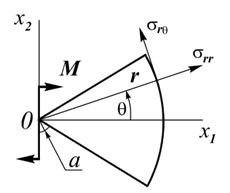
To determine the stress–strain state of a symmetric wedge of unit thickness subjected to bending by a concentrated moment.
Reference
Demidov S.P. "Theory of Elasticity", Moscow, Vysshaya Shkola, 1979.
Problem statement
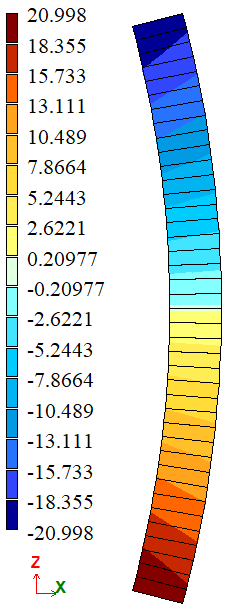
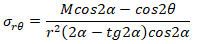
To determine the stress tensor components σrr, σrθ in polar coordinates at a distance of r = 5,25 m from the apex of the wedge.
Design model
A concentrated bending moment M acting in the plane of the wedge is applied at the apex of a wedge of unit thickness.
|
|
|
|
a |
b |
Geometry
Wedge thickness h = 1 m
Radius defining the wedge domain R = 15 m
Wedge apex angle 2α = 30°
Material properties
Modulus of elasticity Е = 3 * 107 kPa
Poisson's ratio ν = 0,2
Boundary conditions
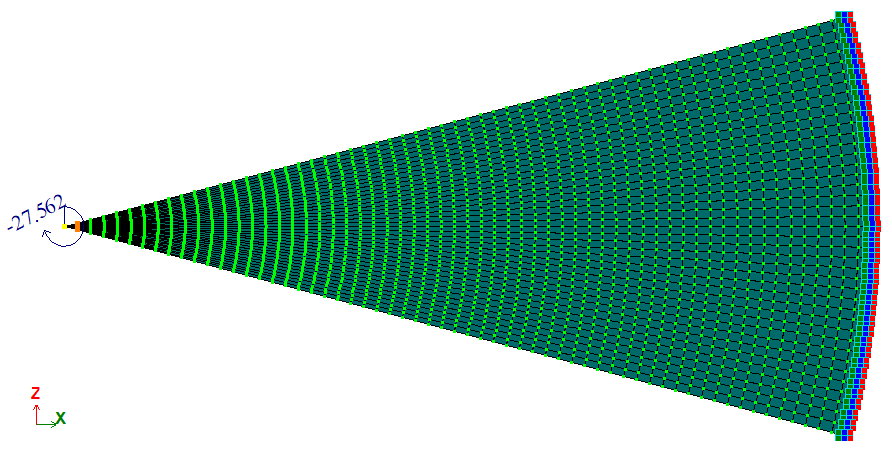
Restraints in all degrees of freedom (DOF) are applied along the arc contour of the wedge.
Loads
Concentrated bending moment: M = 27,5625 kN*m.
Note
The problem is solved in a 3D formulation (model type 5).
The model is generated with FE type 44 – arbitrary quadrilateral FE of shell and FE type 42 – arbitrary triangular FE of shell.
The finite element mesh consists of 60 elements along the radius and 40 elements along the circumference.
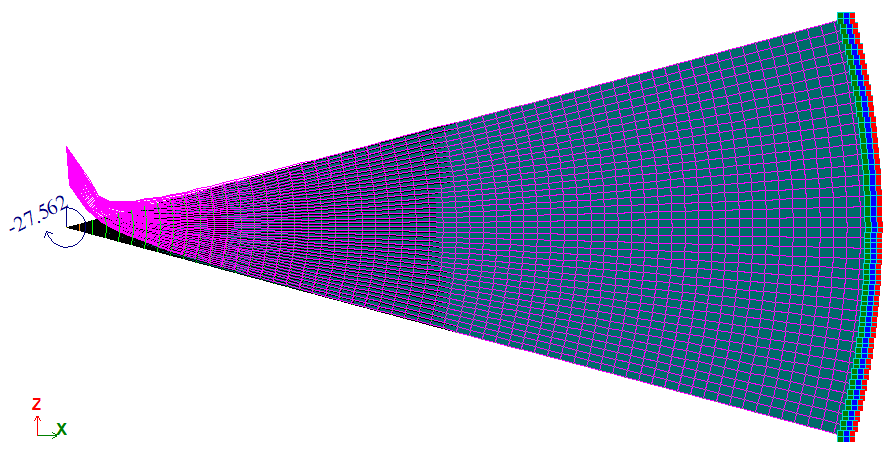
The local axes of plates for the results are aligned in such a way that each local Y1-axis is directed towards the apex of the wedge.
To apply the concentrated moment at the apex of the wedge, the corresponding group of nodes was combined into an absolutely rigid body.
Nodes: 2461. Elements: 2400.
Output data
|
|
|
|
a |
b |
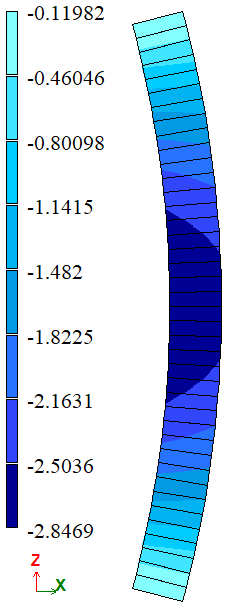
Analytical solution

Comparison of calculation results
Without additional side nodes:
| Point | The unknown | Analytical solution | LIRA-FEM | Error, % |
| r = 5,25 m | σrr, kN/m2 | 21,48 | 20,998 | 2,2439 |
| σrθ, kN/m2 | 2,88 | 2,8469 | 1,1493 |
With additional side nodes:
| Point | The unknown | Analytical solution | LIRA-FEM | Error, % |
| r = 5,25 m | σrr, kN/m2 | 21,48 | 21,069 | 1,9134 |
| σrθ, kN/m2 | 2,88 | 2,8737 | 0,2187 |
Download verification test
If you find a mistake and want to inform us about it, select the mistake, then hold down the CTRL key and click ENTER.
Comments